
AI as the Core Infrastructure of Work | WOXA GROUP
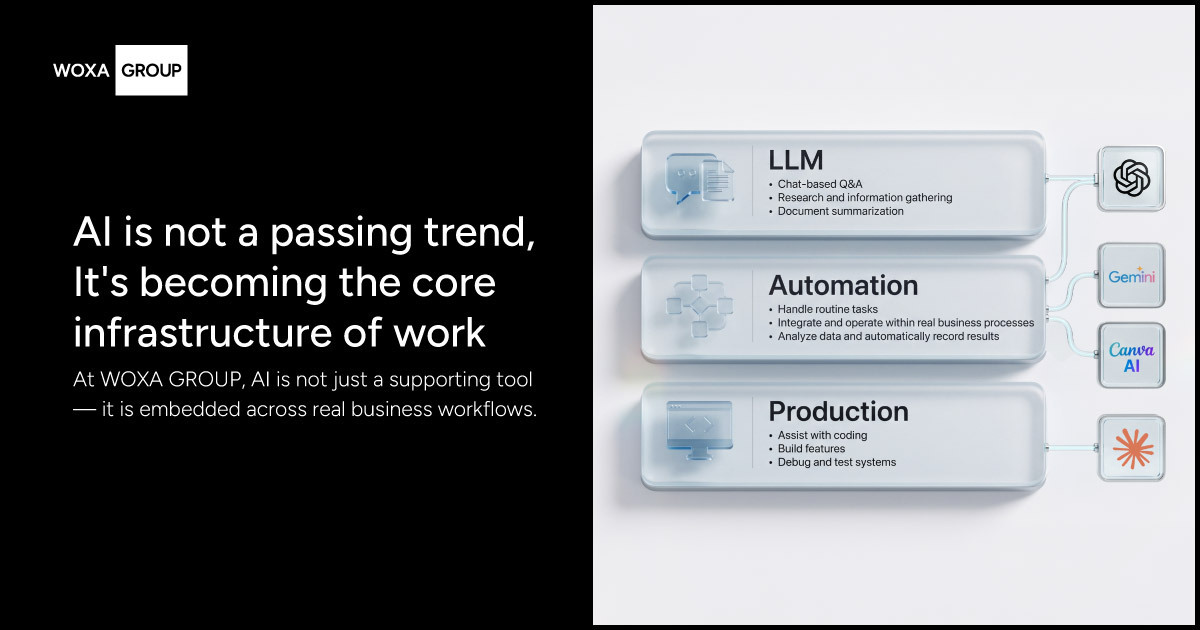
AI is not a passing trend, It’s becoming the core infrastructure of work.
WOXA GROUP's perspective on designing AI to work responsibly with systems, processes, and people.
At WOXA GROUP, our mission is to build and advance the financial infrastructure of the future for businesses within our ecosystem. This same philosophy is reflected in how we adopt Artificial Intelligence (AI) across our organization.
For us, the true value of AI does not lie in having the newest tools. It lies in our ability to apply technology to solve real business problems, integrate seamlessly with existing systems, and empower our people to work more efficiently and systematically.
As AI continues to be embedded into a growing number of business processes, it is evolving beyond an experimental tool or a productivity enhancer. It is becoming a foundational layer of modern organizational infrastructure.
From an occasional assistant to an integrated part of business operations.
AI can be adopted at multiple levels across an organization.
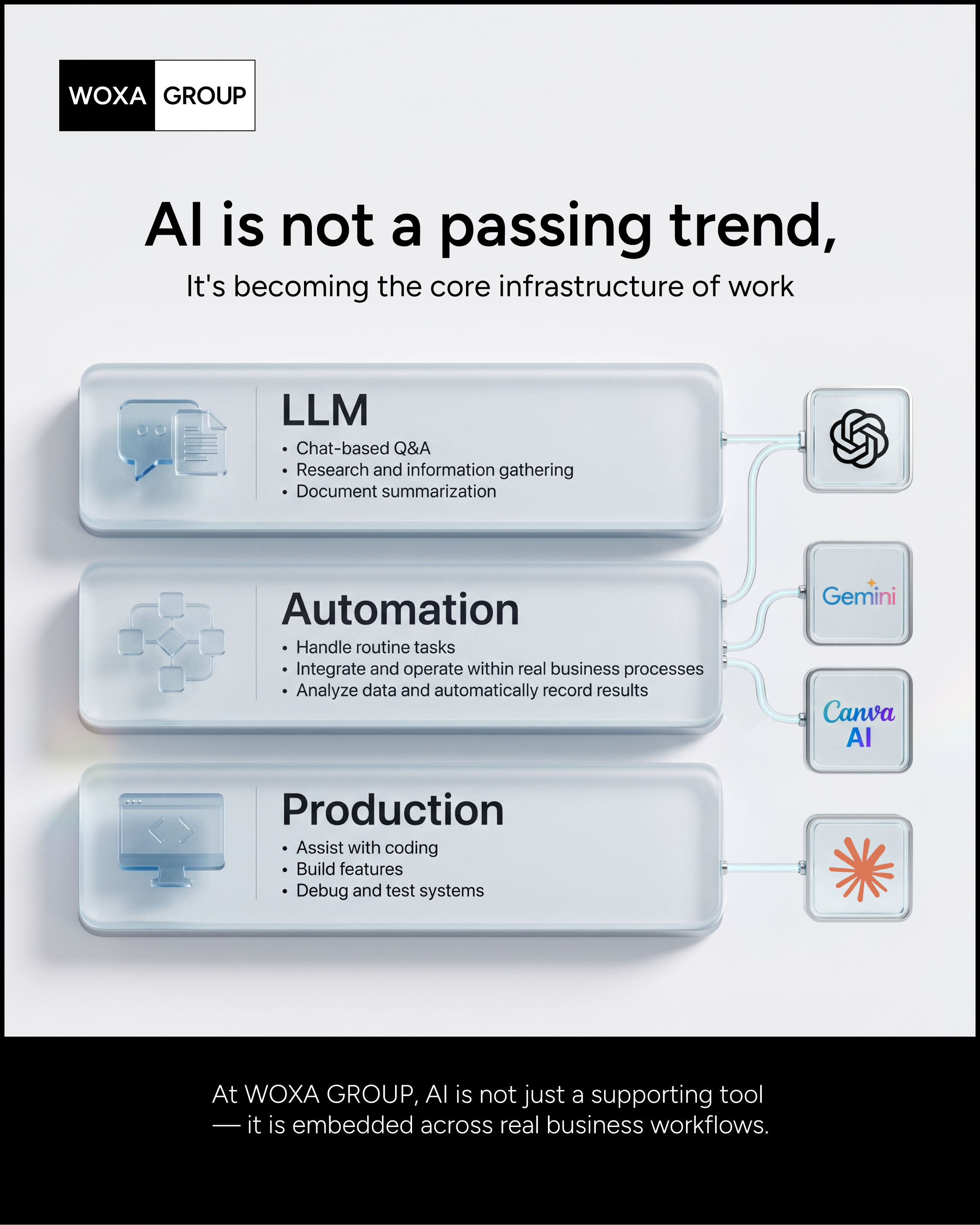
Large Language Models (LLMs) act as intelligent assistants for research, summarization, drafting content, and conducting preliminary analysis, significantly reducing the time spent on repetitive tasks and processing large volumes of information.
Automation enables AI to integrate with existing workflows and business systems, supporting tasks such as data entry, progress tracking, notifications, and preparing information for downstream processes.
Production allows AI to support software development, testing, and the creation of practical business applications under appropriate governance, quality standards, and review processes.
Although these applications differ in scope, they share a common objective: enabling AI to function as part of an organization's operational ecosystem rather than as a collection of isolated tools.
Start with real business problems, not technology trends.
One of WOXA GROUP's guiding principles for AI adoption is to begin with operational challenges rather than the latest technology trends.
The first example is the development of an internal tool that processes operational performance data according to predefined organizational criteria. Previously, employees had to collect and calculate this information manually. The new solution enables data to be prepared in a structured and consistent manner while maintaining human review and oversight.
Another example is the development of a dedicated document watermarking application instead of relying on generative AI to recreate the process each time. This approach improves consistency, reduces unnecessary computing resources, and provides a more reliable operational workflow.
These examples demonstrate that AI does not need to exist in every step of every process. Instead, it should be applied where it creates meaningful business value. This mirrors how organizations use other forms of infrastructure—different departments leverage the same foundation in different ways to support their specific needs. When every team adopts AI according to its own operational context, it signals that AI has become truly embedded within the organization.
Integrating AI into existing workflows.
AI delivers greater value when it complements an organization's existing systems and operational processes.
In document management and administrative coordination, AI helps prepare information, summarize project progress, generate reminders, and condense lengthy discussions into actionable insights, enabling teams to identify key issues and respond more efficiently.
For contract-related processes, AI can assist with preliminary document reviews and highlight areas that require additional attention. However, final review and approval remain the responsibility of the designated personnel.
Likewise, organizations can enhance existing business systems through automation for document requests, internal coordination, and various support functions, reducing repetitive manual work without requiring a complete replacement of current platforms.
This observation aligns with what WOXA GROUP's Efficiency Team has identified from AI adoption patterns across multiple departments. Their experience suggests that employees generally adopt AI in two distinct ways, each producing different outcomes.
The first approach focuses on completing existing work more efficiently. AI enables employees to finish familiar tasks more quickly, increasing productivity while remaining within the same scope of responsibilities.
The second approach expands employees' capabilities beyond their existing skill sets. With AI, individuals can build tools and business applications that they previously lacked the technical expertise to develop, even without a formal programming background.
The true value of AI therefore extends beyond speed. Its greatest contribution is enabling people to accomplish work that was previously beyond their capabilities.
As expressed by the team directly responsible for driving operational efficiency:
"AI is more valuable than simply making existing work faster. It enables people to do things they couldn't do before."
— Nattiwut Trakoolsantirat, Efficiency Analyst (Process & Automation), Efficiency Team, WOXA GROUP
AI supports decision-making, it does not replace human responsibility.
Applying AI to people-related processes requires careful and responsible design.
AI can help organize information, present relevant insights, and provide decision-makers with a more comprehensive view of available data. However, it should never serve as the sole basis for evaluation or replace human judgment in decisions that affect employees.
Decisions involving personnel must remain under the responsibility of qualified decision-makers and be supported by appropriate review mechanisms to ensure accuracy, fairness, and the mitigation of potential bias.
This principle also encompasses data protection, access control, and responsible technology governance aligned with the roles and responsibilities of each function within the organization.
The value that matters more than having the newest technology.
What distinguishes AI from many short-lived technology trends is not the number of tools an organization adopts, but its ability to create sustainable, repeatable improvements in day-to-day operations.
When individual teams can apply AI to solve their own operational challenges within a clear governance framework, AI becomes a foundational organizational capability that supports business performance across multiple functions.
At WOXA GROUP, developing AI capabilities is not a race to adopt the newest technology. It is about designing systems that fit the realities of the business, deliver long-term value, and maintain the right balance between efficiency, accuracy, security, and fairness.
Because truly effective infrastructure is not defined solely by how advanced it is—it is defined by whether an organization can rely on it, use it responsibly, and continuously build upon it for the future.